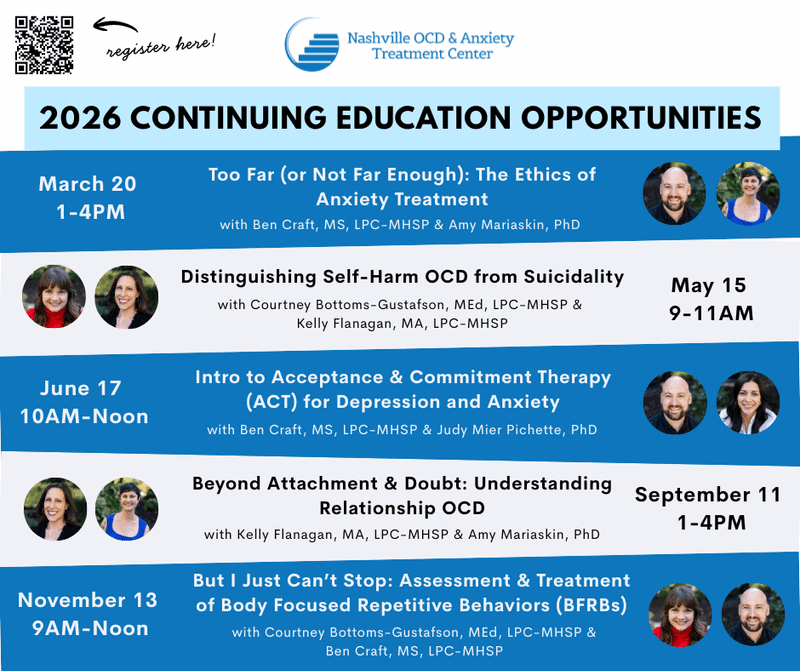
Join Nashville OCD & Anxiety Treatment Center online for a continuing education presentation on distinguishing between self-harm OCD symptoms and suicidality.
Thoughts such as,
What if I jumped off that balcony?
Does having that thought mean I want to kill myself?
I could lose control and stab myself
Why do I keep having these thoughts if I don’t really want to die?
are common experiences for a person living with harm OCD. While these thoughts are unwanted and intrusive, they can alarm clients and therapists who are not familiar with obsessive compulsive disorder (OCD). To avoid unnecessary interventions and reinforcing irrational fears, therapists should educate themselves on the distinction between fearing that one might harm oneself and actually wanting to harm oneself.
This synchronous, interactive virtual presentation provides an overview of harm OCD, with a focus on distinguishing intrusive thoughts of harm from true suicidal ideation or non-suicidal self-injury (NSSI) urges. This presentation is intended for intermediate-level therapists who have some knowledge of OCD. Participants will learn how ego-dystonic thoughts of harm create anxiety and drive compulsive behaviors, like reassurance seeking and avoidance, that fuel the cycle of OCD. This session also includes an overview of non-suicidal self-injury, examines the spectrum of suicidal thoughts and behaviors, reviews assessments that may aid clinicians in distinguishing between ego-syntonic or ego-dystonic harm thoughts, and examines evidence-based treatments for each concern with guidance on how to adapt treatment approaches for clients that experience co-morbid harm OCD and suicidal ideation or non-suicidal self-injury.
Participants can earn 2.0 CE credits for attending the entirety of the presentation. Social workers will also need to complete a brief program evaluation to receive credit.
Learning objectives include:
1. Differentiate between harm OCD and suicidal ideation/non-suicidal self-injury.
2. Identify assessment tools to distinguish intrusive thoughts of harm from genuine suicidal ideation or non-suicidal self-injury urges.
3. Compare evidence-based treatments for harm OCD and suicidality/NSSI.
For questions or concerns, you can contact Dr. Judy Mier Pichette at judy@ocdnashville.com
Schedule
9:00-9:25: Introduction to OCD and the Harm OCD cycle
9:25-9:45: The spectrum of suicidal thoughts and behaviors including NSSI
9:45-10:00: Formal and informal assessment of OCD, suicidal ideation, and NSSI
10:00-10:30: Evidence based treatment of OCD as compared to evidence based treatments for suicidal ideation/NSSI
10:30-10:50: Tailoring treatment when both are present
10:50-11: Wrap up/Q + A
Presenter bios:
Courtney Bottoms Gustafson, MEd, is a Licensed Professional Counselor and Head of Student Development at Nashville OCD & Anxiety Treatment Center. She has worked in the mental health field since 2008 and became a therapist in 2016. Since 2017, she has specialized in OCD and anxiety disorders and has provided treatment at the IOP, PHP, and outpatient levels. Courtney utilizes various modalities under the CBT umbrella including ERP, ACT, DBT, and CBIT in her work with children, adolescents, and adults. Outside of the therapy room, Courtney provides licensure supervision, consultation, and advocates for the OCD community in various ways.
Kelly Flanagan, MA, LPC-MHSP, is a Licensed Professional Counselor and the Clinical Director at the Nashville OCD & Anxiety Treatment Center. She has been working with OCD and related anxiety disorders for more than 10 years. She has presented at the International OCD Foundation annual conference, in addition to providing local talks about OCD and related disorders. As Clinical Director of the NOATC, she is responsible for supervision and training of prelicensed and licensed clinicians. Additionally, she provides consultation for therapists outside of the organization in the areas of OCD and anxiety disorders.
Cancellation/refund policy
A participant may withdraw their registration with a full refund, provided they give 48-hour notice prior to the program start date. If a participant cancels within 48 hours of the start time, they may receive up to a 50% refund determined at the discretion of the continuing education administrative team. No shows for registered participants will not be refunded.
In the event of a program cancellation or postponement by the NOATC, registered participants will be given the option of a full refund or a waived fee for the rescheduled program.
Accreditation Statements
APA: Nashville OCD & Anxiety Treatment Center is approved by the American Psychological Association to sponsor continuing education for psychologists. Nashville OCD & Anxiety Treatment Center maintains responsibility for this program and its content.
ASWB: Nashville OCD & Anxiety Treatment Center, provider #2342, is approved as an ACE provider to offer social work continuing education by the Association of Social Work Boards (ASWB) Approved Continuing Education (ACE) program. Regulatory boards are the final authority on courses accepted for continuing education credit. ACE provider approval period: 4/10/2026-4/10/2029. Social workers completing this course receive 2.0 clinical continuing education credits.
NBCC: Nashville OCD & Anxiety Treatment Center has been approved by NBCC as an Approved Continuing Education Provider, ACEP No. 7498. Programs that do not qualify for NBCC credit are clearly identified. Nashville OCD & Anxiety Treatment Center is solely responsible for all aspects of the programs.
For more information and to see other continuing education offerings, please visit: https://www.ocdnashville.com/continuing-education
Registration will remain open until the beginning of the event. You can request accommodations in the order form when registering.
https://www.eventbrite.com/e/distinguishing-self-harm-ocd-from-suicidal-ideation-tickets-1983828155416?aff=oddtdtcreator